OpenVPN. Managing the module
This article continues from OpenVPN quick start. If you have not installed the module and created the first user yet, start there. The topics here cover operations on the module itself: starting and stopping the service, updating, and uninstalling, plus an OpenVPN-specific feature — the reminder to restart the service after changes in the user list. VPN user management is covered in a separate article — OpenVPN. Managing users.
Managing the service
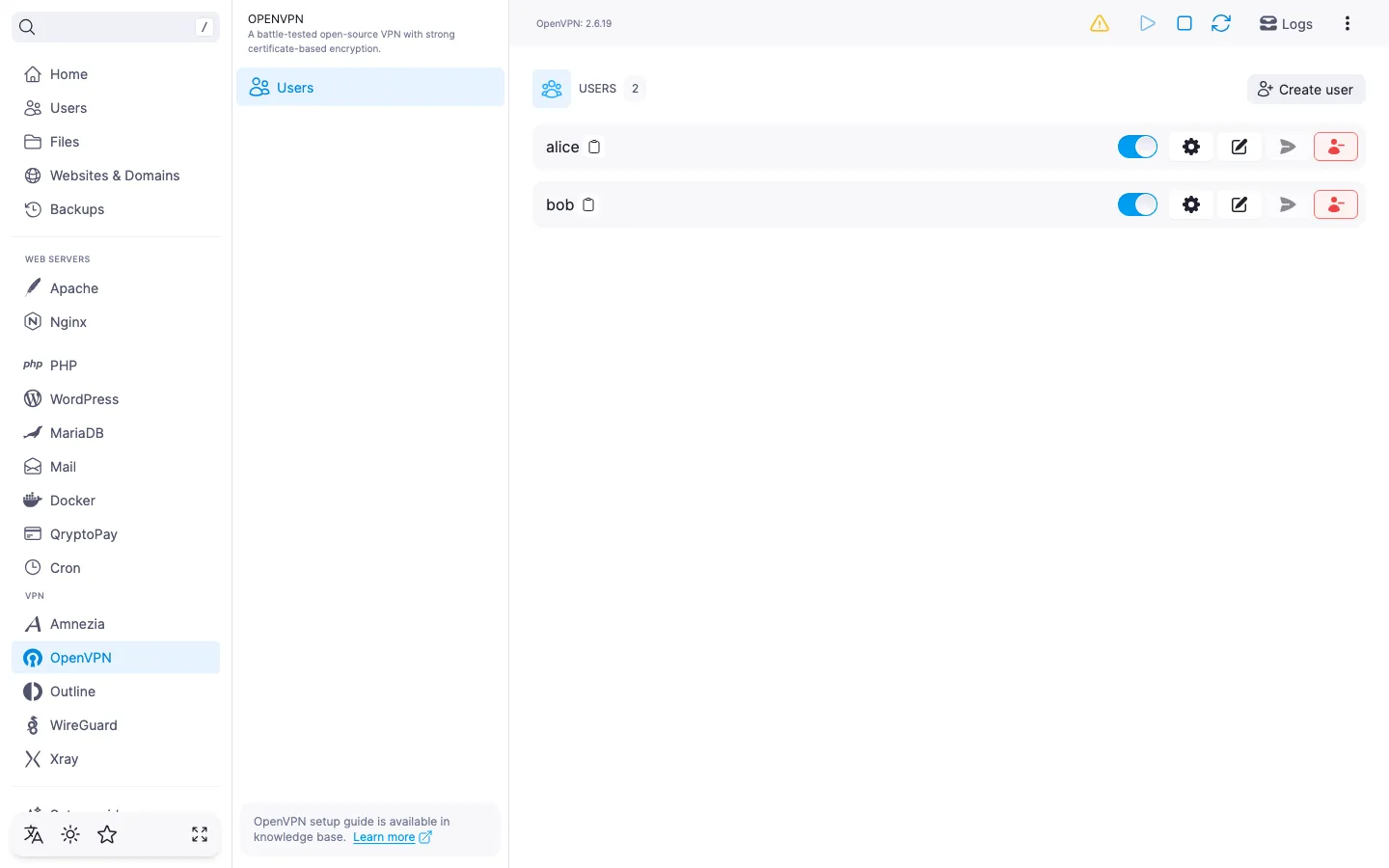
In the top-right corner of the module page, three service controls are available for the OpenVPN service: "Start", "Stop", and "Restart".
- "Start" — brings the service up from a stopped state. The button is active only when the service is currently down.
- "Stop" — shuts the service down. All active VPN connections are dropped, and new ones cannot be established.
- "Restart" — stops the service and immediately starts it again. Open connections are dropped. Used after changes in the user list or if the service has become unstable.
⚠️ Stopping the service drops every VPN connection
While the service is down, no user can connect. Plan stops and restarts for a maintenance window, or notify users in advance.
While the module is being updated or uninstalled, the service controls are temporarily unavailable.
ℹ️ Port
OpenVPN runs on UDP port 1194.
⚠️ ISP restrictions
Traffic encryption makes a VPN a reliable way to protect a connection, but in some countries and regions internet providers actively interfere with VPN protocols. Because of this, full availability of the service cannot be guaranteed — regardless of the connection type. If one protocol does not work for you, try another VPN module available in the panel. If none of them work on your network, contact support and we will issue a refund for the license.
Restart reminder
The OpenVPN server does not re-read the certificate list on the fly: after changes that affect user accounts, the service needs a restart to pick up the current certificate revocation list and the new client configurations.
The reminder appears when you toggle a user in the list (enabling or disabling them) or save an edit in the dialog with the "Enabled" flag changed. A restart reminder with a "Restart" button shows up on the module page. The button triggers the same command as the one in the header: it is active only when the service is running and no other operation is in progress; otherwise, restart the service manually from the page header. Once the service has started or restarted successfully, the reminder disappears.
ℹ️ Changes apply only after a restart
Until the module is restarted, the changes are already saved on the server but have not reached the running OpenVPN process: for example, a re-enabled user will not be able to connect with the new certificate until the restart.
SMTP-not-configured alert
The module page header may show an "Email sending not configured" banner with a "Set up" link. It means the panel has no working SMTP — the .ovpn file cannot be emailed to users. The VPN itself keeps working: the banner concerns email sending only, and downloading .ovpn from the "Connection settings" dialog stays available. SMTP setup is described in How to set up an SMTP relay for sending emails.
Updating the module
In the module action menu next to the "OpenVPN" title, choose "Update OpenVPN". The panel pulls the latest OpenVPN version from the repository and installs it over the current one. The user list and their certificates are preserved.
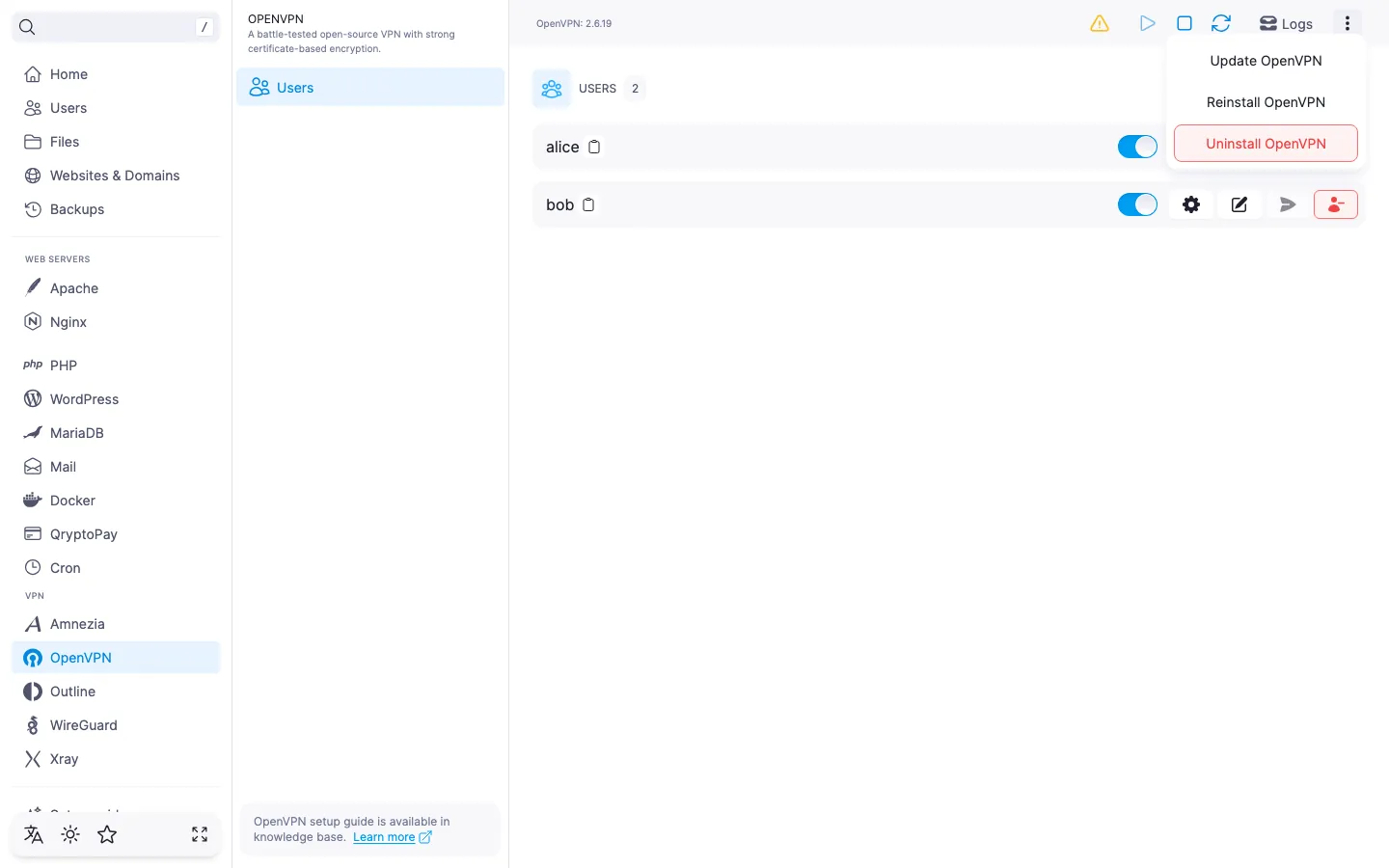
The update has no confirmation prompt — the action starts right away. While it is running, the header shows an "Updating OpenVPN" indicator, and the service controls and menu items are unavailable.
Reinstalling the module
In the module action menu, choose "Reinstall OpenVPN" and click "Confirm". The panel runs the install of the same OpenVPN version over the current one and restarts the service. The user list and their certificates are preserved — there is no need to re-import the .ovpn files on devices. Use it if the service is running unstably: a reinstall brings the module back to its baseline working state without touching the data.
ℹ️ Reinstall keeps users
Unlike uninstalling, reinstalling does not wipe users, certificates, or the generated .ovpn files. Already connected clients keep working with their existing files.
ℹ️ If a connection doesn't recover
If a user can't reconnect after the reinstall, disable them in the list, enable them again and re-import the .ovpn on the device. If the errors persist, the last resort is to fully uninstall the module and install it again.
Uninstalling the module
In the module action menu, choose "Uninstall OpenVPN". The panel asks you to confirm and warns that all users along with their certificates and settings will be removed together with the module.
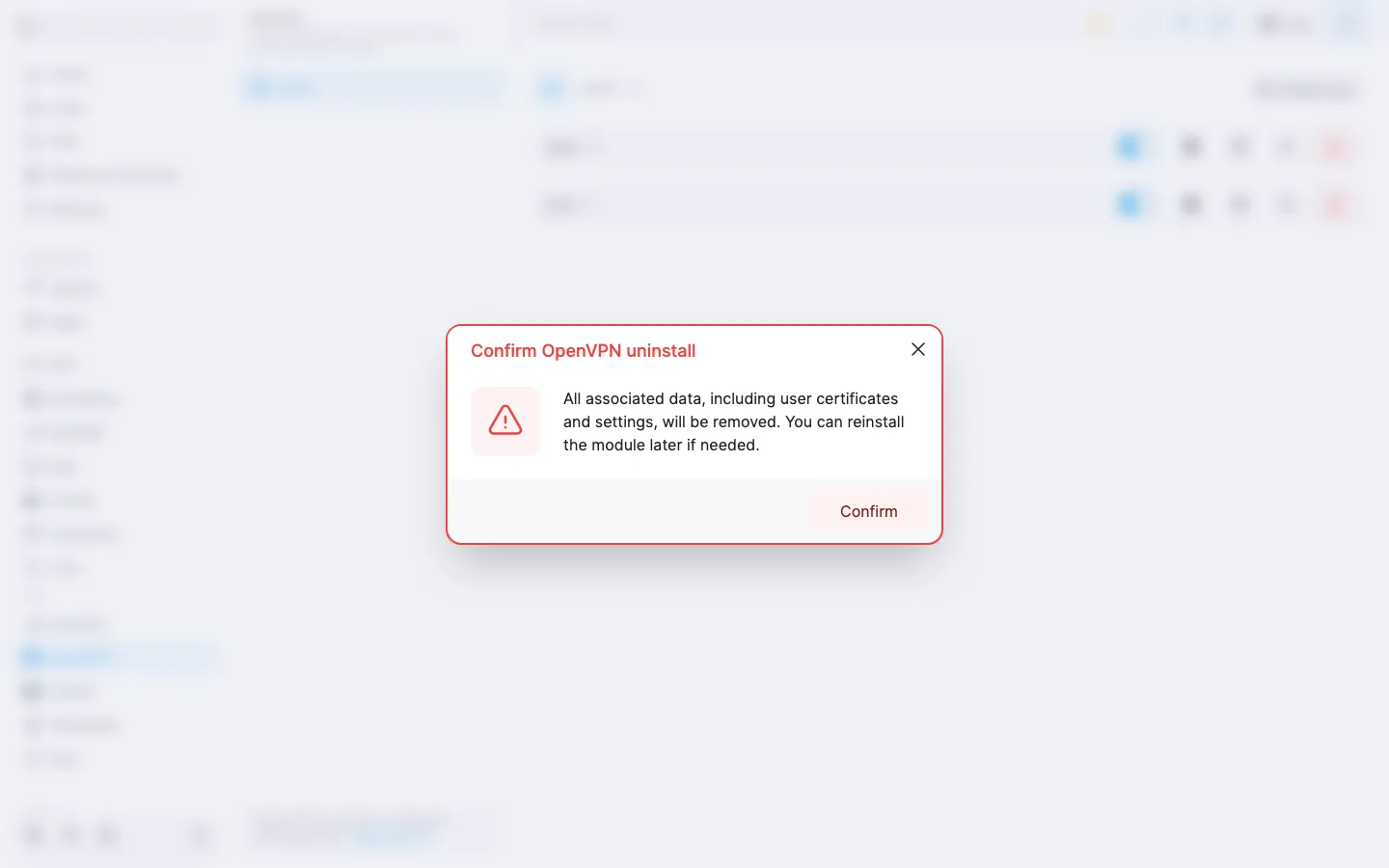
‼️ Uninstalling the module wipes every VPN user
The action is irreversible: along with the module, all OpenVPN users, their certificates, and the generated .ovpn configuration files are deleted. Already installed client apps will fail to connect afterwards — the certificates inside their files will be revoked together with the PKI. After a reinstall, the module and the users have to be created from scratch; new certificates will be issued, and clients will need their .ovpn reissued and re-imported.
After confirmation, the panel starts the uninstall; the process is shown as an "Uninstalling OpenVPN" indicator in the header. When it finishes, the module page returns to its initial state with the "Install" button.
Task log
The module page header has a link to the module task log. It records every lifecycle operation triggered on the module — install, update, uninstall — along with their statuses and execution logs. Useful when an installation or update fails and you need to find the cause.
Useful links
- OpenVPN quick start — installing the module and the first connection.
- OpenVPN. Managing users — creating, editing, revoking certificates, and deleting users.