WireGuard quick start
The WireGuard module in the BeAdmin panel runs your own VPN on the server using the modern WireGuard protocol: a compact codebase, up-to-date cryptography (Curve25519, ChaCha20, Poly1305), and fast connections even on mobile networks. Each user gets a key pair and a ready-to-use .conf configuration file — the panel takes care of the entire server side, including the network interface and the keys.
This article walks through the minimum scenario: install the module, create the first user, and connect a client device to it.
ℹ️ Note
A VPN server of your own beats commercial services: bandwidth is not shared with hundreds of clients, and the WireGuard module in BeAdmin has no limit on the number of users.
⚠️ ISP restrictions
Traffic encryption makes a VPN a reliable way to protect a connection, but in some countries and regions internet providers actively interfere with VPN protocols. Because of this, full availability of the service cannot be guaranteed — regardless of the connection type. If one protocol does not work for you, try another VPN module available in the panel. If none of them work on your network, contact support and we will issue a refund for the license.
Install the module
The module installs with a single click and is ready to use right away: the network interface parameters (UDP port, tunnel subnet, MTU, server DNS) are set automatically on the server side.
In the panel side menu, open "VPN" → "WireGuard" and click "Install". Installation takes a few minutes; you can follow the progress in the task log.
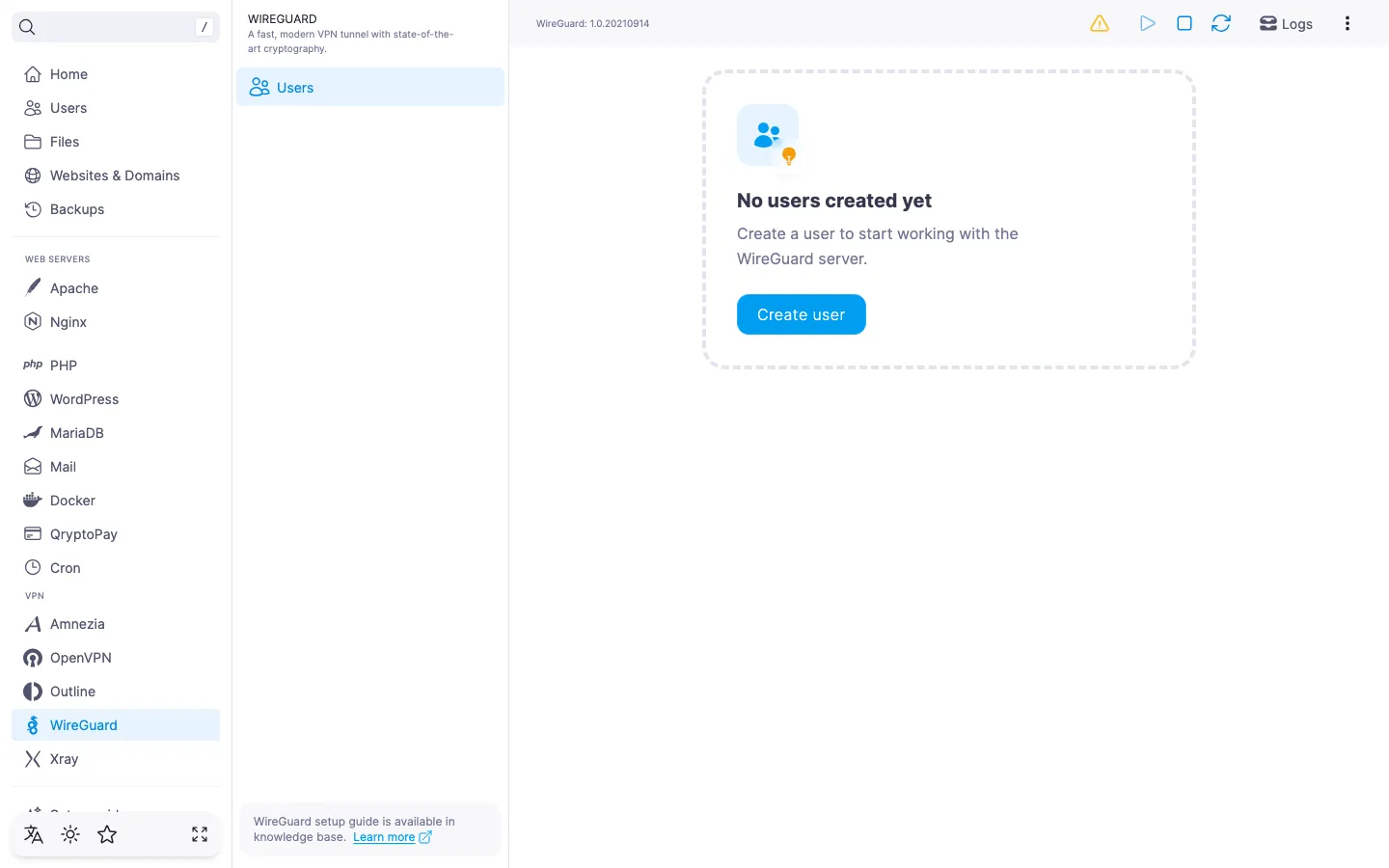
Once it finishes, the panel automatically opens the "Users" page — that is the main screen of the module.
💡 Hint
If installation fails, try running it again.
Create the first user
A WireGuard user is a separate account with its own key pair and .conf configuration file. We recommend creating a separate user for every device that will connect: it makes revoking access for a single device easy, without touching the others.
On the "Users" page, click "Create user".
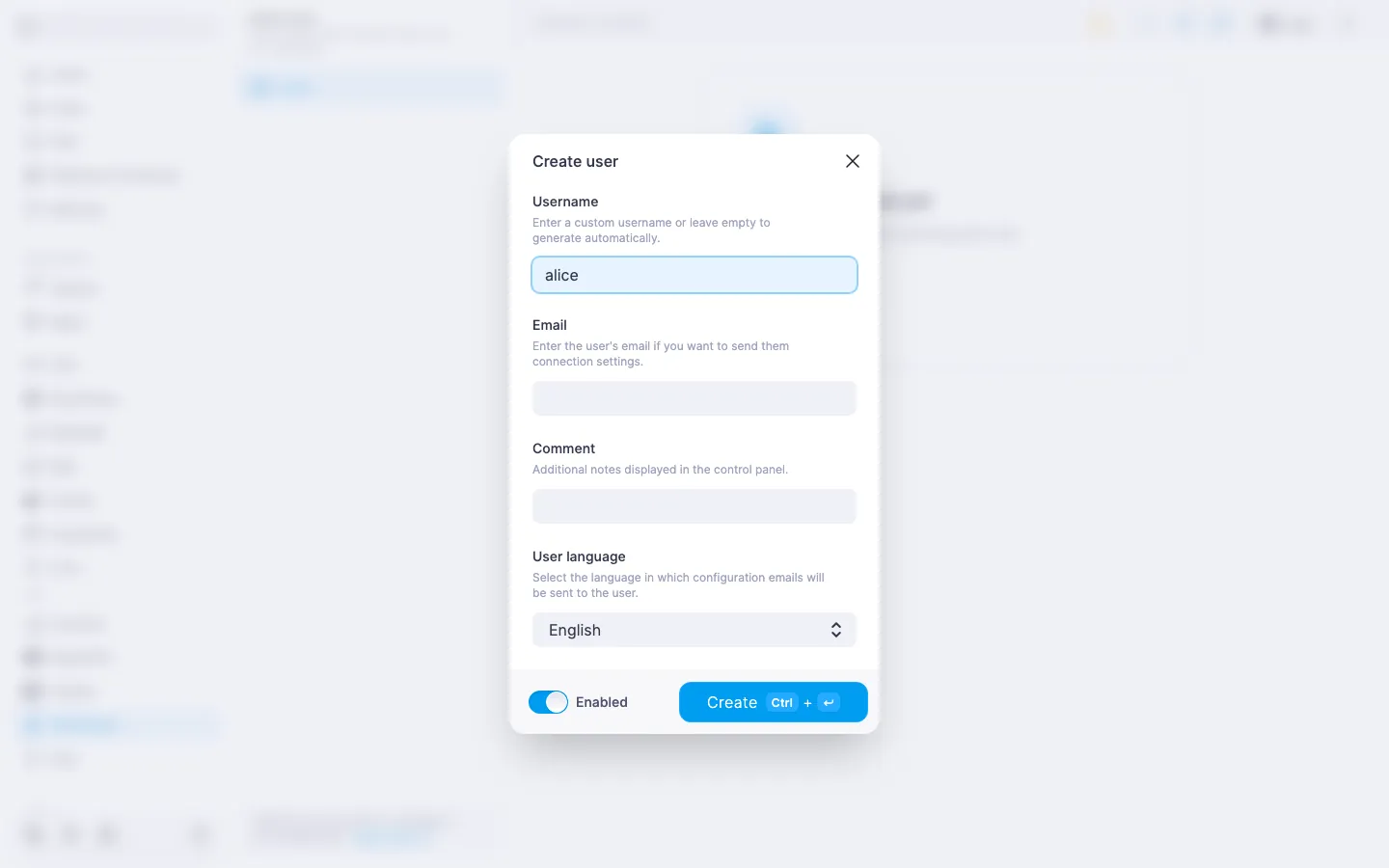
Fill in the form:
- "Username" — 2 to 32 characters (Latin letters, digits, dot, hyphen, underscore); if left empty, the panel generates the name itself.
- "Email" — optional, needed if you plan to send the
.confby mail. - "Comment" — an optional label of up to 64 characters; helps you find users in the list.
- "User language" — language of the email with the configuration. Defaults to English.
- "Enabled" — by default the user is created enabled; turn the toggle off if you don't want to activate them right away.
Click "Create".
The user appears in the list. The server generates a key pair for them and assembles a .conf configuration file — you can grab it right from the connection settings dialog.
ℹ️ Default values
On creation, the panel sets the client DNS server to 1.1.1.1 (Cloudflare) and persistent keepalive to 25 seconds. Both values can be changed in the user edit dialog — see WireGuard. Managing users for details.
Connect a client device
Connecting requires the official WireGuard app. It is available for:
Install the app on the device that will route traffic through the VPN. Next, grab the configuration from the panel.
- In the user row, click the "Settings" button (gear icon).
- The "Connection settings" dialog shows a QR code for the mobile app and a download button for the
.conffile for desktop. The file name matches the username. - Import the configuration into the app:
- On a phone, in the WireGuard app pick "Add a tunnel" → "Create from QR code" and scan the QR code straight from the panel screen. Alternatively, import the downloaded
.conffile. - On a desktop, in the WireGuard app pick "Import tunnel(s) from file" and choose the downloaded
.conf. On Linux the same configuration can be brought up with thewg-quick up <path-to-file>command.
- On a phone, in the WireGuard app pick "Add a tunnel" → "Create from QR code" and scan the QR code straight from the panel screen. Alternatively, import the downloaded
- Activate the tunnel in the app. On iOS, confirm the system prompt to install the VPN profile.
To verify that the VPN works, open any IP-check page in the browser, for example myip.com. If everything is set up correctly, the page shows the country of your server.
Send the configuration by email
If SMTP is configured in the panel, the .conf configuration file can be emailed to the user — handy when you do not have the device on hand.
In the "Connection settings" dialog, click "Send to email"; the same button is also available in the user row in the list. The file is sent to the address entered in the user's profile.
ℹ️ When SMTP is not configured
The send-to-email buttons are disabled, and the module page header shows an "Email sending not configured" banner with a link to the SMTP settings. See How to set up an SMTP relay for sending emails for details. Downloading the .conf file and the QR code work in any case.
What's next
For module management, see WireGuard. Managing the module. For creating, editing, and deleting users, see WireGuard. Managing users. Disabling and re-enabling a user can be done right from the list — no need to re-import the .conf on the device afterwards.