OpenVPN. Managing the module
This article continues OpenVPN quick start. If you have not yet installed the module and created the first user, start there. Collected here are the operations on the module itself: starting and stopping the service, updating, reinstalling, and uninstalling. VPN user management lives in a separate article — OpenVPN. Managing users.
Page header and actions menu
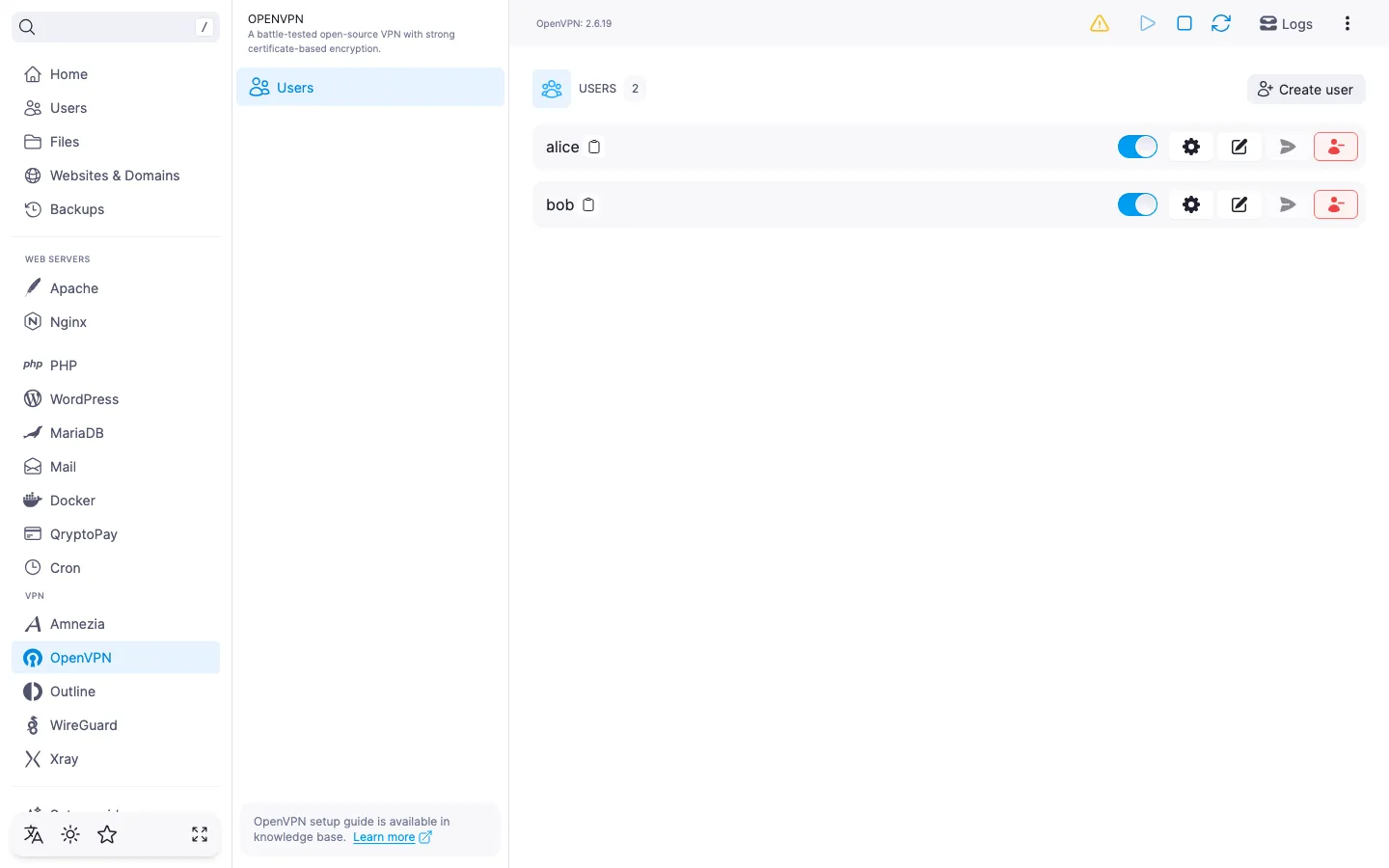
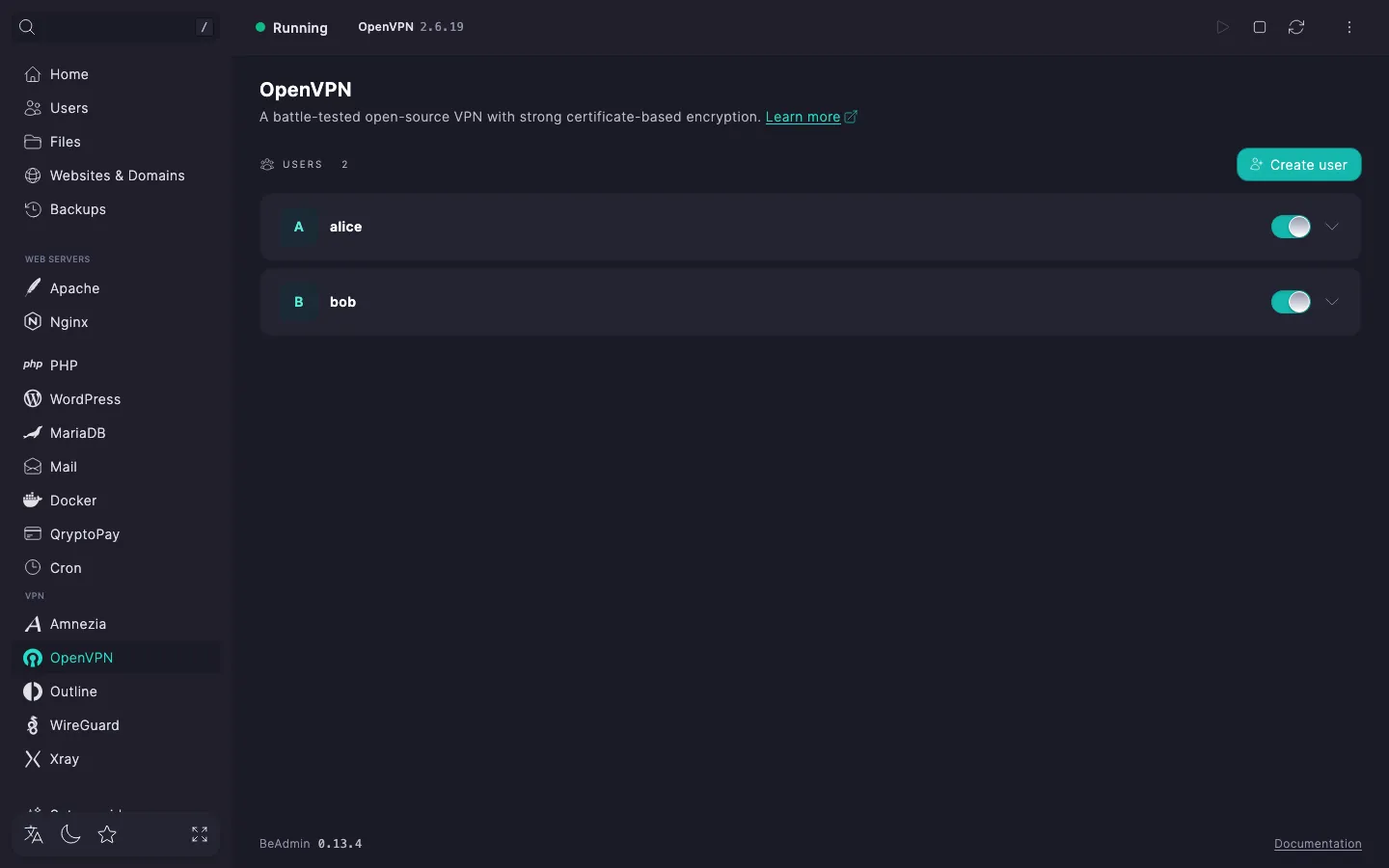
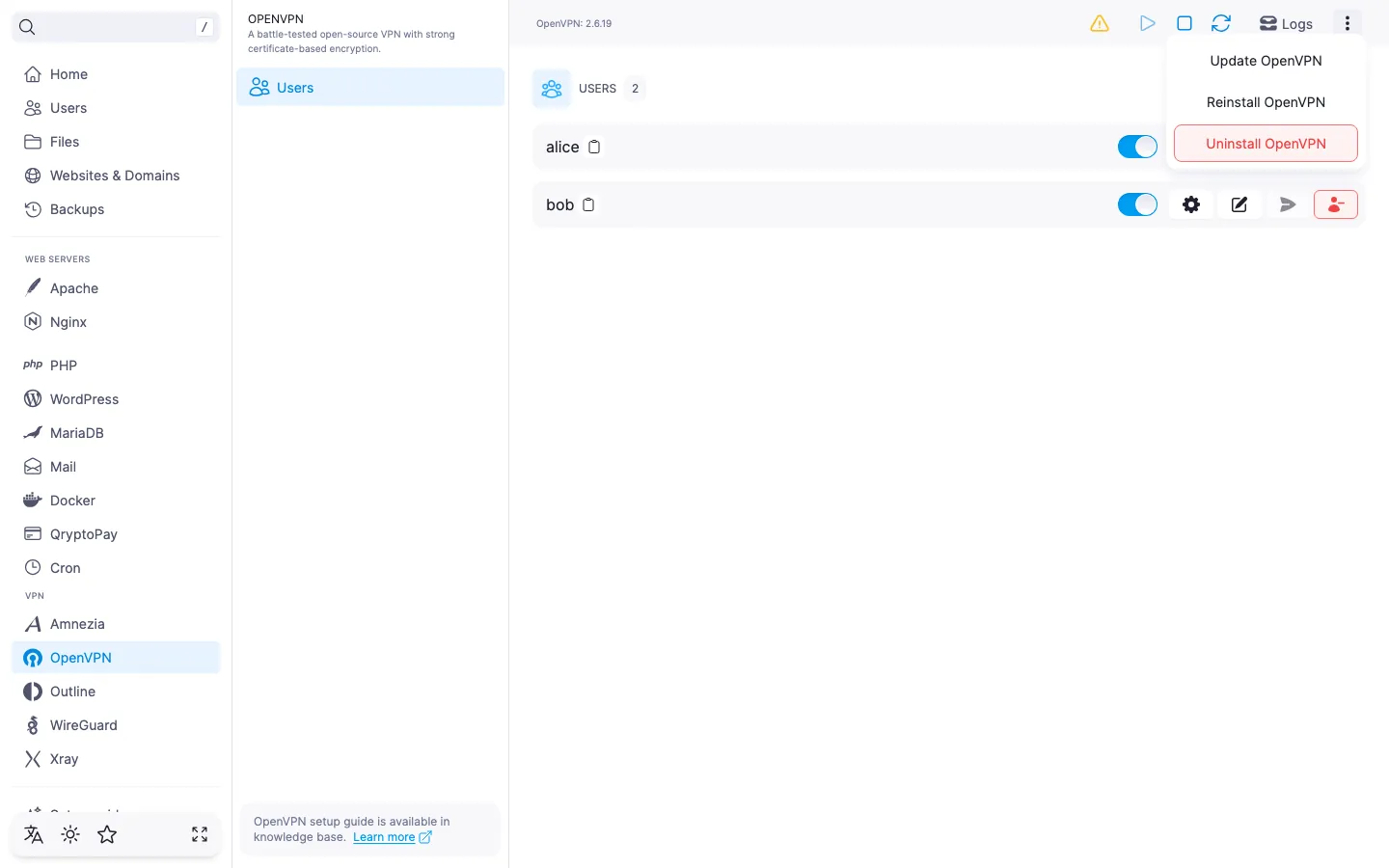
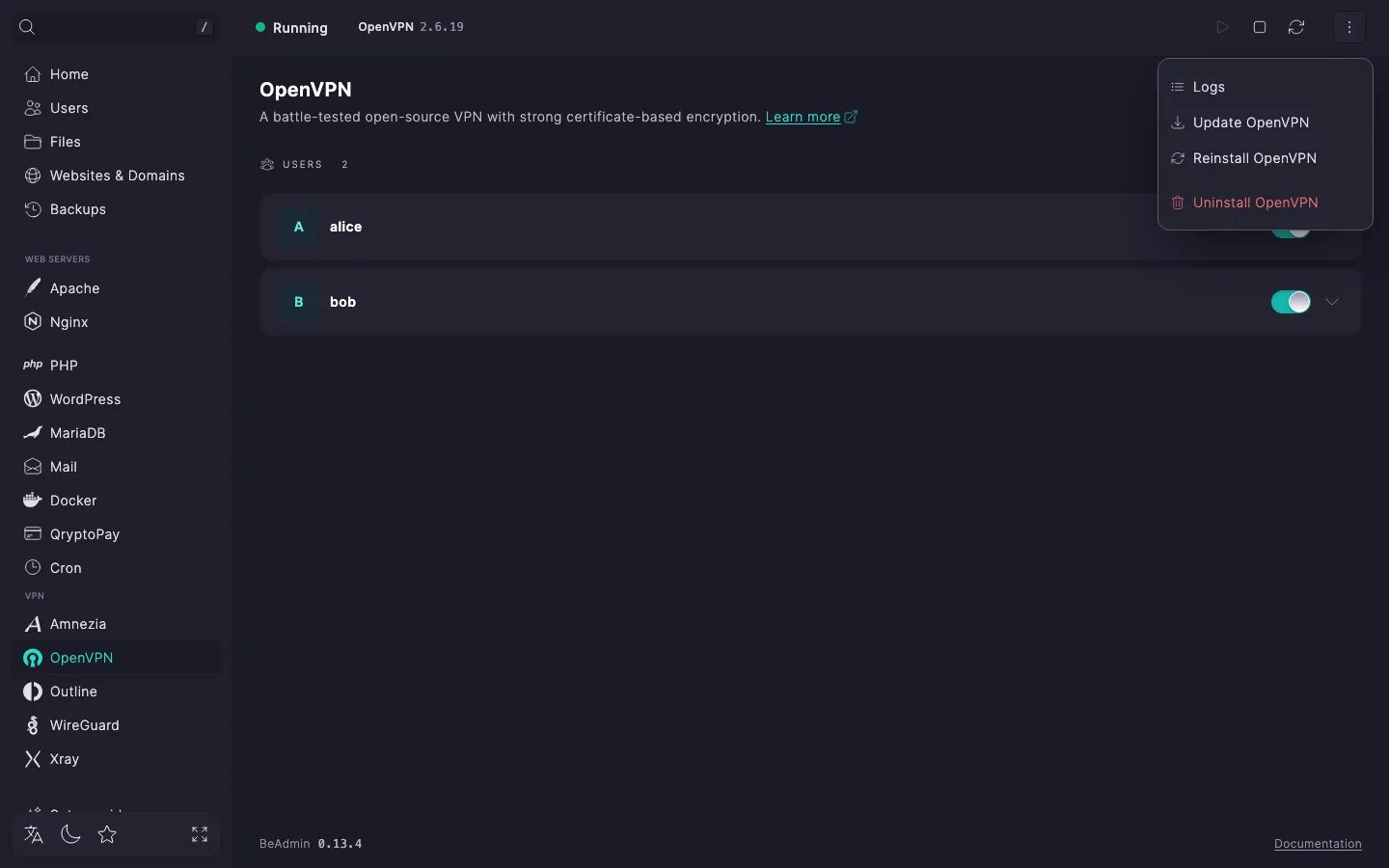
The page header exposes the core module actions — start, stop, and restart the service. The service state is shown by a status indicator and a chip with the OpenVPN version. The three-dot menu next to it holds the rest: open logs, check and run an update, reinstall, or uninstall the module.
Managing the service
- Start — brings the OpenVPN service up from a stopped state.
- Stop — shuts the service down. All active VPN connections drop, and new ones cannot be established.
- Restart — stops and immediately starts the service again. Open connections are reset.
When a user is disabled or deleted, the panel revokes their certificate right away — new connections under it are blocked automatically. A service restart is only needed when you want to drop already active sessions immediately. Enabling a new user and issuing the .ovpn file also work without a restart — the server accepts a connection with a freshly issued certificate right away.
⚠️ Stopping the service drops all VPN connections
While the service is off, no user can connect. Plan stops and restarts for a maintenance window or warn users in advance.
While the module is being updated, reinstalled, or deleted, the service controls and the actions menu are temporarily unavailable.
Logs
In the actions menu pick Logs — the journal of module lifecycle operations opens: install, update, reinstall, delete. Each record shows a status and the full execution output. Useful when an action ends with an error and you need to figure out why.
Server settings
OpenVPN has no separate server settings page: the technical parameters (certificate authority, Diffie–Hellman keys, encryption parameters) are picked by the BeAdmin panel during install and kept under the hood. The server accepts incoming connections over UDP. The default port is 1194; you can choose another at install time (OpenVPN quick start). After installation, the port can only be changed by reinstalling (Reinstalling the module).
Updating the module
In the actions menu pick Update OpenVPN. The panel checks whether a newer OpenVPN version exists in the repository, installs it on top of the current one, and restarts the service. The user list and their certificates are preserved — there is no need to re-import the .ovpn files on devices.
The update has no confirmation step — the action starts immediately. While it runs, the service controls and the menu entries are unavailable; the current module version is visible on the OpenVPN chip in the header. If the latest version is already installed, the update is not started — the panel will tell you so.
Reinstalling the module
In the actions menu pick Reinstall OpenVPN. The panel asks you to confirm the reinstall in the Confirm OpenVPN reinstall dialog — click Confirm. The same OpenVPN version is deployed on top of the current one and the service is restarted. The user list, their certificates, and the generated .ovpn files are preserved — there is no need to re-import the configuration on devices.
Reinstall the module if it behaves unstably and you want to run installation again without losing users. Unlike uninstall, reinstall does not wipe users and their certificates — the already issued .ovpn files keep working without reconnection and without re-import.
A reinstall keeps OpenVPN on its current port and with the same certificate authority. To move the module to a different port, enter it in the reinstall dialog. If the new port is taken, the module won't start until the port is freed.
After the move, the .ovpn files issued earlier stop working — the port is baked into them. The certificates stay the same, but the files need to be issued to users again.
If clients stop connecting after a reinstall, re-download the .ovpn file in the expanded user row and re-import it into the client app. If the errors persist, the last resort is to fully uninstall the module and install it again.
Uninstalling the module
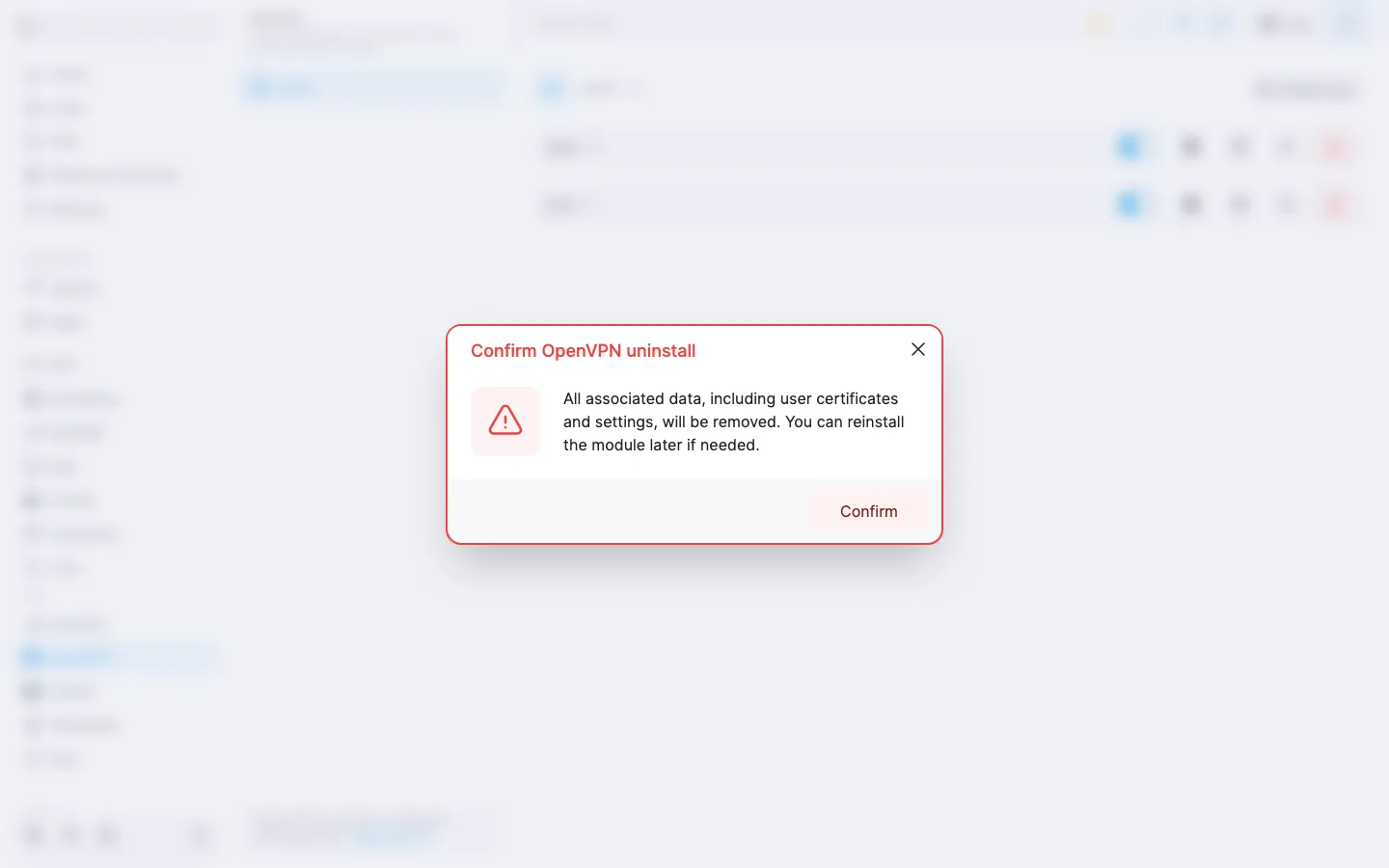
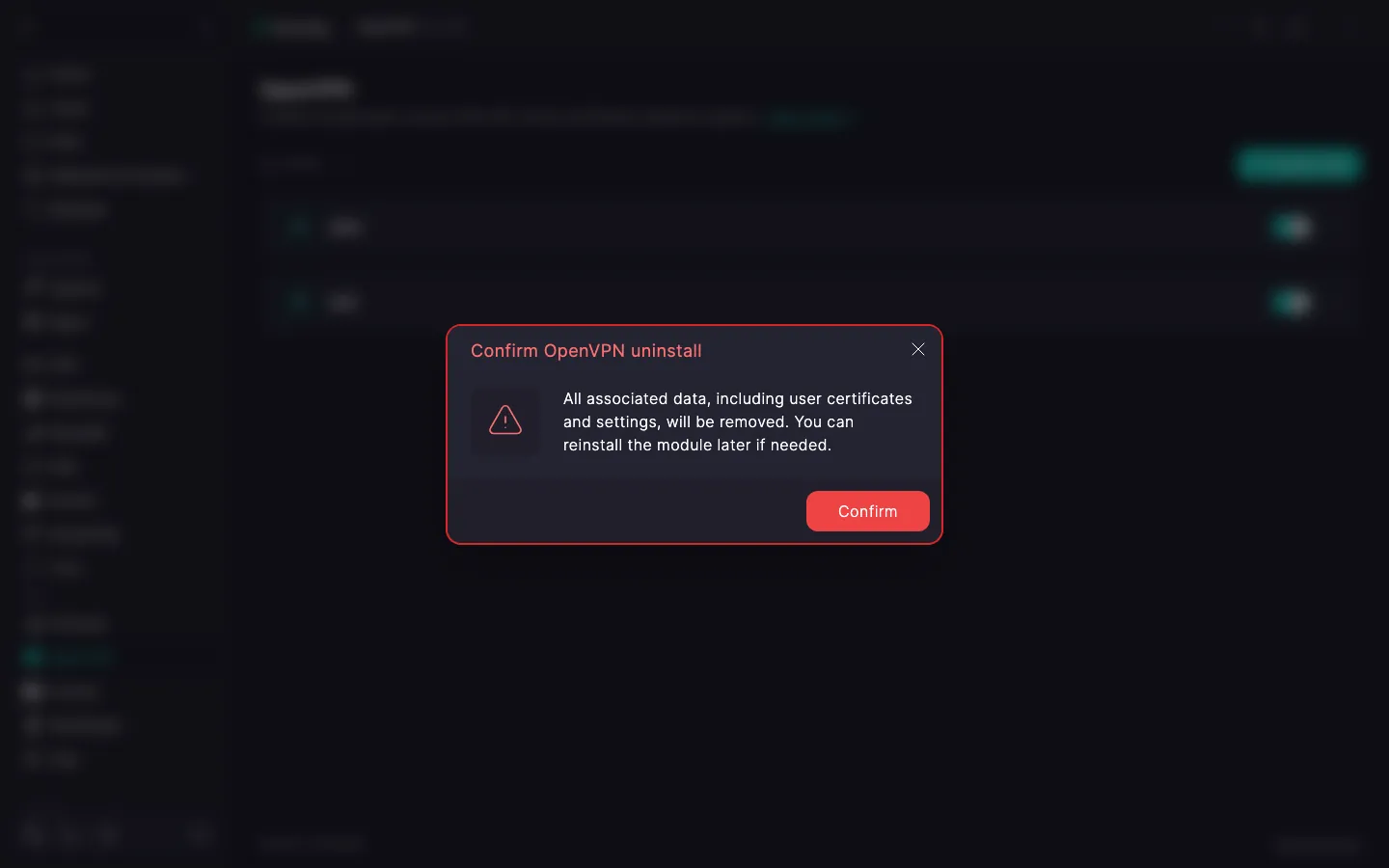
In the actions menu pick Delete OpenVPN. The panel asks you to confirm the deletion in the Confirm OpenVPN module deletion dialog: along with the module, all related data is deleted, including user certificates and settings; after a fresh install the module starts from scratch.
‼️ Deleting the module wipes all VPN users
Deletion is irreversible: along with the module, all OpenVPN users, their certificates, and the generated .ovpn files disappear. Already installed client apps will not be able to connect after the deletion — the certificates in their files become revoked together with the certificate authority. After a fresh install you will have to recreate the module and the users; new certificates will be issued, and clients will need to re-import the .ovpn file.
After confirmation the panel starts the deletion. When it finishes, the module page returns to its initial state with the Install button.
What's next
- OpenVPN quick start — installing the module and the first connection.
- OpenVPN. Managing users — creating, editing, and deleting users.
- How to set up an SMTP relay for sending email — so you can email users their
.ovpnfile.